8 Ways to Feel Confident in Social Situations (Without Losing Your Mind)

Do social situations ever flip a switch in your brain – from “I’m fine” to “Everyone is judging me” in about three seconds? You’re not alone. Anxiety and self-doubt love to show up right when you’d rather feel calm, confident, and completely yourself.

The good news? Confidence isn’t about eliminating anxiety – it’s about not letting it run the show. With a few practical mind shifts and talking to yourself in a gentler way, you can show up feeling more grounded and self-assured around others.

Here are 8 realistic ways to project confidence in any social situation. Make an intentional decision to practice these tips, be patient with yourself, and watch how confidence starts to feel a lot more natural over time.

1. Question the Story in Your Head

Anxiety almost always starts with unhelpful self-talk. Commit to catching those inner negative thoughts as soon as you hear them, “I’m awkward, I’ll mess this up, What if I look or sound stupid…” and simply tell them to “STOP” – do not let these negative messages build a foundation for anxiety.

2. Breathe Like You Mean It

Slow, deep breathing tells your nervous system it’s safe to calm down. Inhale through your nose, exhale through your mouth, and repeat. It’s simple, subtle, and surprisingly powerful.

3. Picture It Going Well

Before walking into a social situation, imagine yourself relaxed, engaged, and enjoying the moment. Visualization helps your brain practice success instead of panic. You are always visualizing – it’s a question of whether the mental picture is a positive or negative one!

4. Move the Spotlight Off of You

Get curious about other people. Confidence grows when your focus moves off of you. Ask questions. Listen. Be interested. When you focus on others, anxiety will begin to naturally fade into the background.
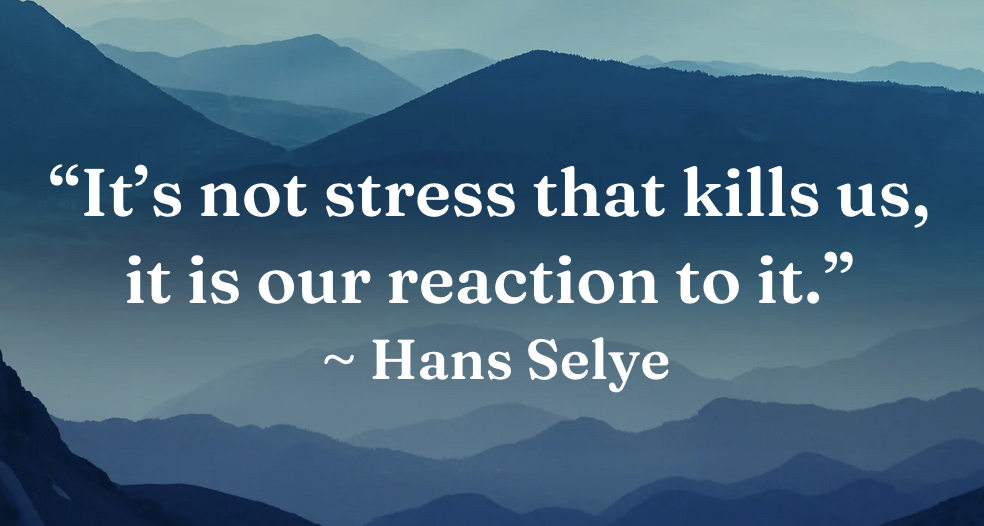
It’s Not Stress That Can Kill You …

In my coaching work, I have discovered that stress in general has a bad reputation. In fact, we talk about it like it’s our enemy – something to be eliminated, escaped, or managed into oblivion. But Hans Selye, the pioneer of stress research, flips the script.

Stress itself isn’t the real problem. Our reaction to it is.

Think about it: stress is unavoidable. Deadlines, traffic, work or performance situations, difficult conversations, unexpected bills, world news – stress is woven into everyday life. If stress alone were fatal, humanity would’ve disappeared centuries ago! Yet people thrive, innovate, and grow under pressure all the time. The difference isn’t the absence of stress; it’s how we interpret and respond to it.

When stress shows up, the body does what it’s designed to do. Our heart rate increases, muscles tense and we experience extreme overthinking. This is the same response that helped our ancestors escape danger and make it through challenging times. In modern life, however, we often treat this natural reaction as a sign that something is wrong. We label stress as dangerous, overwhelming, or intolerable – and that interpretation pours fuel on the fire.

Change the Frame and Change Your Life!

As we enter the New Year, what would happen to your business, your performance, or your life if you could shift your perspective in a way that led to powerful – maybe even amazing – results? (And no, this doesn’t require chanting or a dramatic retreat in the mountains… unless you’re into that.)

“Every picture tells a story, don’t it…”
~ Rod Stewart

I know an artist. Not just any artist – an amazing one. And yes, I’m biased… but she also happens to be my wife. She has an uncanny ability to see what works, what doesn’t, and what still needs “just one more little thing.”

I watch her in her studio take an idea and a blank canvas and, over time, turn it into something magical (VictorianNoel). After what feels like roughly a zillion hours of work, she finally shows me what I’m sure is the finished piece. I tell her, very confidently, “It’s ready. Let’s put it out into the world.”

That’s when she says, “It’s not finished yet. It needs a frame.”

Naturally, I offer to run to the art store and grab one quickly – because how hard could that be?

“No,” she says. “Picking the right frame makes all the difference in the world.”

And, once again, she is right. (She’s right a lot. I’ve learned to pace myself emotionally.)

The right frame can make the artwork look… fine. Or it can make it pop, come alive, and practically shout, Look at me!

The frame matters.

And not just in art. It matters in every area of life. How we frame what we see – and what we tell ourselves about what we see – can change everything.

In fact, an eight-year Harvard University study confirmed just how powerful framing really is. Researchers followed 30,000 people who reported having high levels of stress. That group had a 43% higher risk of dying prematurely.

Yikes.

But here’s the twist.

(Video) Overcome Fear Through the Power of Visualization

If you cannot ‘see’ yourself performing well, or living life without anxiety and fear, then you have very little chance of actually doing that, especially under pressure.

In this video, I share a powerful performance enhancement skill that, when practiced and applied, allows you to rehearse, review and focus on optimal performance in any stressful situation.

Click here to watch the short, but powerful, video.

Life Only Moves When You Act: 4 Steps to Turn Wishes Into Achievement

Here is a quote that says it all if your desire is to move past your fears and achieve your dreams and goals:

“It is important that you get clear for yourself that your only access to impacting life is action. The world does not care what you intend, how committed you are, how you feel or what you think, and certainly it has no interest in what you want and don’t want. Take a look at life as it is lived and see for yourself that the world only moves for you when you act.” ~ Werner Erhard

Pretty straightforward, right? We can plan, dream, and make vision boards all day long – but nothing changes until we actually do something. Action is the bridge between where you are now and where you want to be. Without it, even the best intentions stay stuck in your head.

So how do you start moving from your desires and good ideas to real progress? Here are four practical steps:

1. Start Small – Really Small

Big goals are exciting, but they can also feel overwhelming. That’s why the trick is to shrink them down into tiny, doable steps (Remember the movie ‘What About Bob?’ – “Baby steps…baby steps…”) . Want to write a book? Forget about the 300 pages – just write one paragraph today. Want to overcome your fear of public speaking – begin a daily practice of deep, focused breathing to calm your anxiety. Want to get healthier? Lace up your sneakers and take a quick walk around the block. Don’t wait for the “perfect plan” – just start where you are.

2. Let Consistency Create Momentum & Power

One action on its own won’t change your life, but repeated actions will. The secret is showing up over and over again, even when you don’t feel like it. Think of it like brushing your teeth – it’s the regular, steady effort that makes the difference, not one big heroic burst. Small steps, stacked up, turn into big wins.

When Your Mind Races: A Simple Practice to Return to the Present

Sometimes, life moves fast – faster than we can keep up. Whether it’s preparing for a big presentation, stepping into a high-pressure performance, or simply feeling overwhelmed by a long to-do list, anxiety has a way of pulling us out of the moment.

In those times, staying present can feel like a challenge. Our minds race ahead in anxious anticipation or through past worries or fears. That’s where a simple technique comes in. It’s called the 5-4-3-2-1 technique, and it’s one of the most grounded ways to bring yourself back into the present moment.

I think of it as mindful distraction. You’re not ignoring what’s happening – you’re gently redirecting your focus to what’s real, right now.

Here’s how it works:

Start with a Breath

Before anything else, pause and take one slow, intentional focused breath. Inhale deeply through your nose… exhale through your mouth. Let your shoulders soften. As I share with my coaching clients, this type of breath is always your entry point to the present.

5 – Notice Five Things You Can See

Take a slow look around. Name five things you can see in your environment. It could be the light filtering through the window, the curve of your coffee mug, a photo on the wall, or the pattern in the rug. Let your eyes settle on each one for just a moment.

4 – Notice Four Things You Can Feel

Now, shift your attention to touch. What’s making contact with your body? The texture of your clothes, the chair beneath you, your hands resting on your lap. Choose four sensations and quietly notice how each one feels.

The Words That Kill Dreams – and What to Do About Them (Part 2)

“When we argue for our limitations, we get to keep them.” – Evelyn Waugh

If you’re dreaming big – whether as a creative, performer, entrepreneur, or anyone with a bold vision – then you already know this truth: your words shape your world.

In Part 1, I shared how certain words can quietly kill our creativity, confidence, and joy. Not just the words others say to us – but the words we say to ourselves.

And if you’ve ever wondered why a goal feels out of reach or why you stall just before momentum kicks in, chances are, it’s not your talent or ability holding you back. It’s your inner voice.

Here are six more dream-killing words and phrases to watch for. Each one may sound subtle – even reasonable – but together, they can quietly derail your goals and delay the life you’re meant to live.

Let’s rewrite the story.

6. “It’s hard”

Let’s be honest: dreams can be hard. But “hard” doesn’t mean “impossible.” When we label something as too difficult, we start shrinking our goals down to something safer, smaller, more manageable – and far less exciting.

You weren’t born to settle. Instead of saying, “It’s hard,” try:
“This will grow me.”
“I’m willing to figure it out.”

That’s how every breakthrough begins.

7. “Yes, but…”

This phrase pretends to be supportive, then pulls the rug out from under your progress.
“I’d love to launch my business, but I don’t have the time.”
“I really want to perform again, but I’m rusty.”

Every “yes, but…” is a dream shrinker. Replace it with:
“Yes, and…”
“I’m figuring out how.”