
8 Ways to Feel Confident in Social Situations (Without Losing Your Mind)

Do social situations ever flip a switch in your brain – from “I’m fine” to “Everyone is judging me” in about three seconds? You’re not alone. Anxiety and self-doubt love to show up right when you’d rather feel calm, confident, and completely yourself.

The good news? Confidence isn’t about eliminating anxiety – it’s about not letting it run the show. With a few practical mind shifts and talking to yourself in a gentler way, you can show up feeling more grounded and self-assured around others.

Here are 8 realistic ways to project confidence in any social situation. Make an intentional decision to practice these tips, be patient with yourself, and watch how confidence starts to feel a lot more natural over time.

1. Question the Story in Your Head

Anxiety almost always starts with unhelpful self-talk. Commit to catching those inner negative thoughts as soon as you hear them, “I’m awkward, I’ll mess this up, What if I look or sound stupid…” and simply tell them to “STOP” – do not let these negative messages build a foundation for anxiety.

2. Breathe Like You Mean It

Slow, deep breathing tells your nervous system it’s safe to calm down. Inhale through your nose, exhale through your mouth, and repeat. It’s simple, subtle, and surprisingly powerful.

3. Picture It Going Well

Before walking into a social situation, imagine yourself relaxed, engaged, and enjoying the moment. Visualization helps your brain practice success instead of panic. You are always visualizing – it’s a question of whether the mental picture is a positive or negative one!

4. Move the Spotlight Off of You

Get curious about other people. Confidence grows when your focus moves off of you. Ask questions. Listen. Be interested. When you focus on others, anxiety will begin to naturally fade into the background.
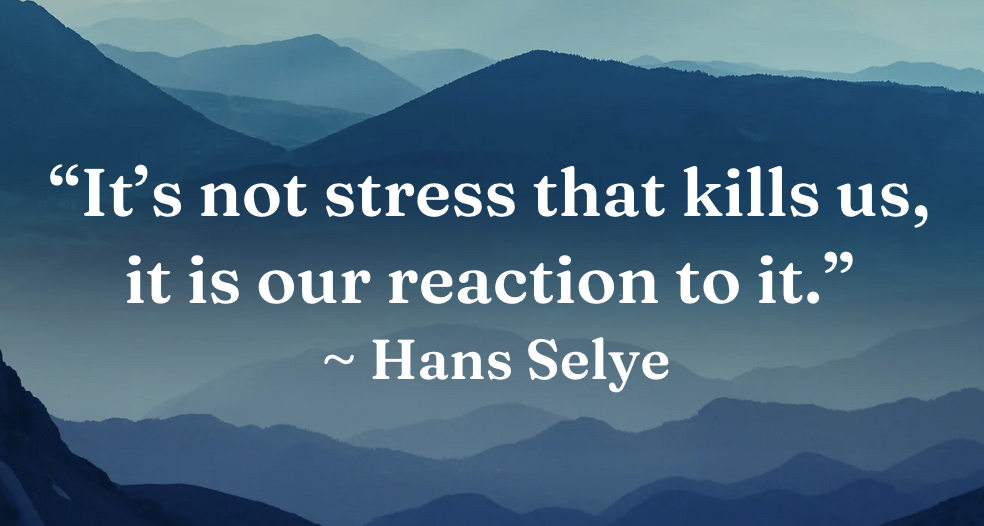
It’s Not Stress That Can Kill You …

In my coaching work, I have discovered that stress in general has a bad reputation. In fact, we talk about it like it’s our enemy – something to be eliminated, escaped, or managed into oblivion. But Hans Selye, the pioneer of stress research, flips the script.

Stress itself isn’t the real problem. Our reaction to it is.

Think about it: stress is unavoidable. Deadlines, traffic, work or performance situations, difficult conversations, unexpected bills, world news – stress is woven into everyday life. If stress alone were fatal, humanity would’ve disappeared centuries ago! Yet people thrive, innovate, and grow under pressure all the time. The difference isn’t the absence of stress; it’s how we interpret and respond to it.

When stress shows up, the body does what it’s designed to do. Our heart rate increases, muscles tense and we experience extreme overthinking. This is the same response that helped our ancestors escape danger and make it through challenging times. In modern life, however, we often treat this natural reaction as a sign that something is wrong. We label stress as dangerous, overwhelming, or intolerable – and that interpretation pours fuel on the fire.

Change the Frame and Change Your Life!

As we enter the New Year, what would happen to your business, your performance, or your life if you could shift your perspective in a way that led to powerful – maybe even amazing – results? (And no, this doesn’t require chanting or a dramatic retreat in the mountains… unless you’re into that.)

“Every picture tells a story, don’t it…”
~ Rod Stewart

I know an artist. Not just any artist – an amazing one. And yes, I’m biased… but she also happens to be my wife. She has an uncanny ability to see what works, what doesn’t, and what still needs “just one more little thing.”

I watch her in her studio take an idea and a blank canvas and, over time, turn it into something magical (VictorianNoel). After what feels like roughly a zillion hours of work, she finally shows me what I’m sure is the finished piece. I tell her, very confidently, “It’s ready. Let’s put it out into the world.”

That’s when she says, “It’s not finished yet. It needs a frame.”

Naturally, I offer to run to the art store and grab one quickly – because how hard could that be?

“No,” she says. “Picking the right frame makes all the difference in the world.”

And, once again, she is right. (She’s right a lot. I’ve learned to pace myself emotionally.)

The right frame can make the artwork look… fine. Or it can make it pop, come alive, and practically shout, Look at me!

The frame matters.

And not just in art. It matters in every area of life. How we frame what we see – and what we tell ourselves about what we see – can change everything.

In fact, an eight-year Harvard University study confirmed just how powerful framing really is. Researchers followed 30,000 people who reported having high levels of stress. That group had a 43% higher risk of dying prematurely.

Yikes.

But here’s the twist.